
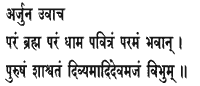
Arjuna said: Thou art the supreme Brahman, the supreme Abode, the supreme Purity, the one permanent, the divine Purusha, the original Godhead, the Unborn, the all-pervading Lord.
The Theory of the Vibhuti
Sri Aurobindo
THE IMPORTANCE of this chapter of the Gita is very much greater than appears at first view or to an eye of prepossession which is looking into the text only for the creed of the last transcendence and the detached turning of the human soul away from the world to a distant Absolute. The message of the Gita is the gospel of the Divinity in man who by force of an increasing union unfolds himself out of the veil of the lower Nature, reveals to the human soul his cosmic spirit, reveals his absolute transcendences, reveals himself in man and in all beings. The potential outcome here of this union, this divine Yoga, man growing towards the Godhead, the Godhead manifest in the human soul and to the inner human vision, is our liberation from limited ego and our elevation to the higher nature of a divine humanity. For dwelling in this greater spiritual nature and not in the mortal weft, the tangled complexity of the three gunas, man, one with God by knowledge, love and will and the giving up of his whole being into the Godhead, is able indeed to rise to the absolute Transcendence, but also to act upon the world, no longer in ignorance, but in the right relation of the individual to the Supreme, in the truth of the Spirit, fulfilled in immortality, for God in the world and no longer for the ego. To call Arjuna to this action, to make him aware of the being and power that he is and of the Being and Power whose will acts through him, is the purpose of the embodied Godhead. To this end the divine Krishna is his charioteer; to this end there came upon him that great discouragement and deep dissatisfaction with the lesser human motives of his work; to substitute for them the larger spiritual motive this revelation is given to him in the supreme moment of the work to which he has been appointed. The vision of the World-Purusha and the divine command to action is the culminating point to which he was being led. That is already imminent; but without the knowledge now given to him through the Vibhuti-Yoga it would not bring with it its full meaning. The mystery of the world-existence is in part revealed by the Gita. In part, for who shall exhaust its infinite depths or what creed or philosophy say that it has enlightened in a narrow space or shut up in a brief system all the significance of the cosmic miracle? But so far as is essential for the Gita’s purpose, it is revealed to us. We have the way of the origination of the world from God, the immanence of the Divine in it and its immanence in the Divine, the essential unity of all existence, the relation of the human soul obscured in Nature to the Godhead, its awakening to self-knowledge, its birth into a greater consciousness, its ascension into its own spiritual heights. But when this new self-vision and consciousness have been acquired in place of the original ignorance, what will be the liberated man’s view of the world around him, his attitude towards the cosmic manifestation of which he has now the central secret? He will have first the knowledge of the unity of existence and the regarding eye of that knowledge. He will see all around him as souls and forms and powers of the one divine Being.Henceforward that vision will be the starting-point of all the inward and outward operations of his consciousness; it will be the fundamental seeing, the spiritual basis of all his actions. He will see all things and every creature living, moving and acting in the One, contained in the divine and eternal Existence. But he will also see that One as the Inhabitant in all, their Self, the essential Spirit within them without whose secret presence in their conscious nature they could not at all live, move or act and without whose will, power, sanction or sufferance not one of their movements at any moment would be in the least degree possible. Themselves too, their soul, mind, life and physical mould he will see only as a result of the power, will and force of this one Self and Spirit. Allwill be to him a becoming of this one universal Being. Their consciousness he will see to be derived entirely from its consciousness, their power and will to be drawn from and dependent on its power and will, their partial phenomenon of nature to be a resultant from its greater divine Nature, whether in the immediate actuality of things it strikes the mind as a manifestation or a disguise, a figure or a disfigurement of the Godhead. No untoward or bewildering appearance of things will in any smallest degree diminish or conflict with the completeness of this vision. It is the essential foundation of the greater consciousness into which he has arisen, it is the indispensable light that has opened around him and the one perfect way of seeing, the one Truth that makes all others possible. But the world is only a partial manifestation of the Godhead, it is not itself that Divinity. The Godhead is infinitely greater than any natural manifestation can be. By his very infinity, by its absolute freedom he exists beyond all possibility of integral formulation in any scheme of worlds or extension of cosmic Nature, however wide, complex, endlessly varied this and every world may seem to us,—n¯ asti anto vistarasya me,—however to our finite view infinite. Therefore beyond cosmos the eye of the liberated spirit will see the utter Divine. Cosmos he will see as a figure drawn from the Divinity who is beyond all figure, a constantminor term in the absolute existence. Every relative and finite he will see as a figure of the divine Absolute and Infinite, and both beyond all finites and through each finite he will arrive at that alone, see always that beyond each phenomenon and natural creature and relative action and every quality and every happening; looking at each of these things and beyond it, he will find in the Divinity its spiritual significance. These things will not be to his mind intellectual concepts or this attitude to the world simply a way of thinking or a pragmatic dogma. For if his knowledge is conceptual only, it is a philosophy, an intellectual construction, not a spiritual knowledge and vision, not a spiritual state of consciousness. The spiritual seeing of God and world is not ideative only, not even mainly or primarily ideative. It is direct experience and as real, vivid, near, constant, effective, intimate as to the mind its sensuous seeing and feeling of images, objects and persons. It is only the physical mind that thinks of God and spirit as an abstract conception which it cannot visualise or represent to itself except by words and names and symbolic images and fictions. Spirit sees spirit, the divinised consciousness sees God as directly and more directly, as intimately and more intimately than bodily consciousness sees matter. It sees, feels, thinks, senses the Divine. For to the spiritual consciousness all manifest existence appears as a world of spirit and not a world of matter, not a world of life, not a world even of mind; these other things are to its view only God-thought, God-force, God-form. That is what the Gita means by living and acting in Vasudeva, mayi vartate. The spiritual consciousness is aware of the Godhead with that close knowledge by identity which is so much more tremendously real than any mental perception of the thinkable or any sensuous experience of the sensible. It is so aware even of the Absolute who is behind and beyond all world-existence and who originates and surpasses it and is for ever outside its vicissitudes. And of the immutable self of this Godhead that pervades and supports the world’s mutations with his unchanging eternity, this consciousness is similarly aware, by identity, by the oneness of this self with our own timeless unchanging immortal spirit. It is aware again in the same manner of the divine Person who knows himself in all these things and persons and becomes all things and persons in his consciousness and shapes their thoughts and forms and governs their actions by his immanent will. It is intimately conscious of God absolute, God as self, God as spirit, soul and nature. Even this external Nature it knows by identity and self-experience, but an identity freely admitting variation, admitting relations, admitting greater and lesser degrees of the action of the one power of existence. For Nature is God’s power of various self-becoming, a¯tma-vibhu¯ ti. But this spiritual consciousness of world-existence will not see Nature in the world as the normal mind of man sees it in the ignorance or only as it is in the effects of the ignorance. All in this Nature that is of the ignorance, all that is imperfect or painful or perverse and repellent, does not exist as an absolute opposite of the nature of the Godhead, but goes back to something behind itself, goes back to a saving power of spirit in which it can find its own true being and redemption. There is an original and originating Supreme Prakriti, in which the divine power and will to be enjoys its own absolute quality and pure revelation. There is found the highest, there the perfect energy of all the energies we see in the universe. That is what presents itself to us as the ideal nature of the Godhead, a nature of absolute knowledge, absolute power and will, absolute love and delight. And all the infinite variations of its quality and energy, ananta-gun. a, agan. ana-´sakti, are there wonderfully various, admirably and spontaneously harmonised free self-formulations of this absolute wisdom and will and power and delight and love. All is there a many-sided untrammelled unity of infinites. Each energy, each quality is in the ideal divine nature pure, perfect, self-possessed, harmonious in its action; nothing there strives for its own separate limited self-fulfilment, all act in an inexpressible oneness. There all dharmas, all laws of being—dharma, law of being, is only characteristic action of divine energy and quality, gun. a-karma,—are one free and plastic dharma. The one divine Power of being1 works with an immeasurable liberty and, tied to no single excluding law, not limited by any binding system, rejoices in her own play of infinity and never falters in her truth of self-expression perfect for ever. But in the universe in which we live, there is a separating principle of selection and differentiation. There we see each energy, each quality which comes out for expression labouring as if for its own hand, trying to get as much self-expression as it can in whatever way it can, and accommodating somehow as best or as worst it may that effort with the concomitant or rival effort of other energies and qualities for their separate self-expression. The Spirit, the Divine dwells in this struggling world-nature and imposes on it a certain harmony by the inalienable law of the inner secret oneness on which the action of all these powers is based. But it is a relative harmony which seems to result from an original division, to emerge from and subsist by the shock of divisions and not from an original oneness. Or at least the oneness seems to be suppressed and latent, not to
find itself, never to put off its baffling disguises. And in fact it does not find itself till the individual being in this world-nature discovers in himself the higher divine Prakriti from whom this lesser movement is a derivation. Nevertheless, the qualities and energies at work in the world, operating variously in man, animal, plant, inanimate thing, are, whatever forms they may take, always divine qualities and energies. All energies and qualities are powers of the Godhead. Each comes from the divine Prakriti there, works for its self-expression in the lower Prakriti here, increases its potency of affirmation and actualised values under these hampering conditions, and as it reaches its heights of selfpower, comes near to the visible expression of the Divinity and directs itself upward to its own absolute in the supreme, the ideal, the divine Nature. For each energy is being and power of the Godhead and the expansion and self-expression of energy is always the expansion and expression of the Godhead. One might even say that at a certain point of intensity each force in us, force of knowledge, force of will, force of love, force of delight, can result in an explosion which breaks the shell of the lower formulation and liberates the energy from its separative action into union with the infinite freedom and power of the divine Being. A highest Godward tension liberates the mind through an absolute seeing of knowledge, liberates the heart through an absolute love and delight, liberates the whole existence through an absolute concentration of will towards a greater existence. But the percussion and the delivering shock come by the touch of the Divine on our actual nature which directs the energy away from its normal limited separative action and objects towards the Eternal, Universal and Transcendent, orientates it towards the infinite and absolute Godhead. This truth of the dynamic omnipresence of the divine Power of being is the foundation of the theory of the Vibhuti. The infinite divine Shakti is present everywhere and secretly supports the lower formulation, par¯a prakr. tir me yay¯a dh¯aryate jagat, but it holds itself back, hidden in the heart of each natural existence, sarvabh ¯ ut¯an¯a ˙ m hr. dde´se, until the veil of Yogamaya is rent by the light of knowledge. The spiritual being of man, the Jiva, possesses the divineNature. He is amanifestation of God in that Nature, par¯a prakr. tir jı¯va-bhu¯ ta¯ , and he has latent in him all the divine energies and qualities, the light, the force, the power of being of the Godhead. But in this inferior Prakriti in which we live, the Jiva follows the principle of selection and finite determination, and there whatever nexus of energy, whatever quality or spiritual principle he brings into birth with him or brings forward as the seed of his self-expression, becomes an operative portion of his swabhava, his law of self-becoming, and determines his swadharma, his law of action. And if that were all, there would be no perplexity or difficulty; the life of man would be a luminous unfolding of godhead. But this lower energy of our world is a nature of ignorance, of egoism, of the three gunas. Because this is a nature of egoism, the Jiva conceives of himself as the separative ego: he works out his selfexpression egoistically as a separative will to be in conflict as well as in association with the same will to be in others. He attempts to possess the world by strife and not by unity and harmony; he stresses an ego-centric discord. Because this is a nature of ignorance, a blind seeing and an imperfect or partial self-expression, he does not know himself, does not know his law of being, but follows it instinctively under the ill-understood compulsion of the world-energy, with a struggle, with much inner conflict, with a very large possibility of deviation. Because this is a nature of the three gunas, this confused and striving self-expression takes various forms of incapacity, perversion or partial self-finding. Dominated by the guna of tamas, the mode of darkness and inertia, the power of being works in a weak confusion, a prevailing incapacity, an unaspiring subjection to the blind mechanism of the forces of the Ignorance. Dominated by the guna of rajas, the mode of action, desire and possession, there is a struggle, there is an effort, there is a growth of power and capacity, but it is stumbling, painful, vehement, misled by wrong notions, methods and ideals, impelled to a misuse, corruption and perversion of right notions, methods or ideals and prone, especially, to a great, often an enormous exaggeration of the ego. Dominated by the guna of sattwa, the mode of light and poise and peace, there is a more harmonious action, a right dealing with the nature, but right only within the limits of an individual light and a capacity unable to exceed the better forms of this lower mental will and knowledge. To escape from this tangle, to rise beyond the ignorance, the ego and the gunas is the first real step towards divine perfection. By that transcendence the Jiva finds his own divine nature and his true existence. The liberated eye of knowledge in the spiritual consciousness does not in its outlook on the world see this struggling lower Nature alone. If we perceive only the apparent outward fact of our nature and others’ nature, we are looking with the eye of the ignorance and cannot know God equally in all, in the sattwic, the rajasic, the tamasic creature, in God and Titan, in saint and sinner, in the wise man and the ignorant, in the great and in the little, in man, animal, plant and inanimate existence. The liberated vision sees three things at once as the whole occult truth of the natural being. First and foremost it sees the divine Prakriti in all, secret, present, waiting for evolution; it sees her as the real power in all things, that which gives its value to all this apparent action of diverse quality and force, and it reads the significance of these latter phenomena not in their own language of ego and ignorance, but in the light of the divineNature. Therefore it sees too, secondly, the differences of the apparent action in Deva and Rakshasa, man and beast and bird and reptile, good and wicked, ignorant and learned, but as action of divine quality and energy under these conditions, under these masks. It is not deluded by the mask, but detects behind every mask the Godhead. It observes the perversion or the imperfection, but it pierces to the truth of the spirit behind, it discovers it even in the perversion and imperfection self-blinded, struggling to find itself, groping through various forms of self-expression and experience towards complete self-knowledge, towards its own infinite and absolute. The liberated eye does not lay undue stress on the perversion and imperfection, but is able to see all with a complete love and charity in the heart, a complete understanding in the intelligence, a complete equality in the spirit. Finally, it sees the upward urge of the striving powers of the Will to be towards Godhead; it respects, welcomes, encourages all high manifestations of energy and quality, the flaming tongues of the Divinity, the mounting greatnesses of soul and mind and life in their intensities uplifted from the levels of the lower nature towards heights of luminous wisdom and knowledge, mighty power, strength, capacity, courage, heroism, benignant sweetness and ardour and grandeur of love and self-giving, preeminent virtue, noble action, captivating beauty and harmony, fine and godlike creation. The eye of the spirit sees and marks out the rising godhead of man in the great Vibhuti. This is a recognition of the Godhead as Power, but power in its widest sense, power not only of might, but of knowledge, will, love, work, purity, sweetness, beauty. The Divine is being, consciousness and delight, and in the world all throws itself out and finds itself again by energy of being, energy of consciousness and energy of delight; this is a world of the works of the divine Shakti. That Shakti shapes herself here in innumerable kinds of beings and each of them has its own characteristic powers of her force. Each power is the Divine himself in that form, in the lion as in the hind, in the Titan as in the God, in the inconscient sun that flames through ether as in man who thinks upon earth. The deformation given by the gunas is the minor, not really the major aspect; the essential thing is the divine power that is finding self-expression. It is the Godhead who manifests himself in the great thinker, the hero, the leader of men, the great teacher, sage, prophet, religious founder, saint, lover of man, the great poet, the great artist, the great scientist, the ascetic self-tamer, the tamer of things and events and forces. The work itself, the high poem, the perfect form of beauty, the deep love, the noble act, the divine achievement is a movement of godhead; it is the Divine in manifestation. This is a truth which all ancient cultures recognised and respected, but one side of the modern mind has singular repugnances to the idea, sees in it a worship of mere strength and power, an ignorant or self-degrading hero-worship or a doctrine of the Asuric superman. Certainly, there is an ignorant way of taking this truth, as there is an ignorant way of taking all truths; but it has its proper place, its indispensable function in the divine economy of Nature. The Gita puts it in that right place and perspective. It must be based on the recognition of the divine self in all men and all creatures; it must be consistent with an equal heart to the great and the small, the eminent and the obscure manifestation. God must be seen and loved in the ignorant, the humble, the weak, the vile, the outcaste. In the Vibhuti himself it is not, except as a symbol, the outward individual that is to be thus recognised and set high, but the one Godhead who displays himself in the power. But this does not abrogate the fact that there is an ascending scale in manifestation and that Nature mounts upward in her degrees of self-expression from her groping, dark or suppressed symbols to the first visible expressions of the Godhead. Each great being, each great achievement is a sign of her power of self-exceeding and a promise of the final, the supreme exceeding. Man himself is a superior degree of natural manifestation to the beast and reptile, though in both there is the one equal Brahman. But man has not reached his own highest heights of self-exceeding and meanwhile every hint of a greater power of theWill to be in him must be recognised as a promise and an indication. Respect for the divinity in man, in all men, is not diminished, but heightened and given a richer significance by lifting our eyes to the trail of the great Pioneers who lead or point him by whatever step of attainment towards supermanhood. Arjuna himself is a Vibhuti; he is a man high in the spiritual evolution, a figure marked out in the crowd of his contemporaries, a chosen instrument of the divineNarayana, the Godhead in humanity. In one place the Teacher speaking as the supreme and equal Self of all declares that there is none dear to him, none hated, but in others he says that Arjuna is dear to him and his bhakta and therefore guided and safe in his hands, chosen for the vision and the knowledge. There is here only an apparent inconsistency. The Power as the self of the cosmos is equal to all, therefore to each being he gives according to the workings of his nature; but there is also a personal relation of the Purushottama to the human being in which he is especially near to the man who has come near to him. All these heroes and men of might who have joined in battle on the plain of Kurukshetra are vessels of the divine Will and through each he works according to his nature but behind the veil of his ego. Arjuna has reached that point when the veil can be rent and the embodied Godhead can reveal the mystery of his workings to his Vibhuti. It is even essential that there should be the revelation. He is the instrument of a great work, a work terrible in appearance but necessary for a long step forward in the march of the race, a decisive movement in its struggle towards the kingdom of the Right and the Truth, dharmar¯ ajya. The history of the cycles of man is a progress towards the unveiling of the Godhead in the soul and life of humanity; each high event and stage of it is a divine manifestation. Arjuna, the chief instrument of the hidden Will, the great protagonist, must become the divine man capable of doing the work consciously as the action of the Divine. So only can that action become psychically alive and receive its spiritual import and its light and power of secret significance. He is called to self-knowledge; he must see God as theMaster of the universe and the origin of the world’s creatures and happenings, all as the Godhead’s self-expression in Nature, God in all, God in himself as man and as Vibhuti, God in the lownesses of being and on its heights, God on the topmost summits, man too upon heights as the Vibhuti and climbing to the last summits in the supreme liberation and union. Time in its creation and destruction must be seen by him as the figure of the Godhead in its steps,—steps that accomplish the cycles of the cosmos on whose spires of movement the divine spirit in the human body rises doing God’s work in the world as his Vibhuti to the supreme transcendences. This knowledge has been given; the Time-figure of the Godhead is now to be revealed and from the million mouths of that figure will issue the command for the appointed action to the liberated Vibhuti.
Sri Aurobindo
 About Us | ©1999 - 2009 searchforlight.org
All extracts and quotations from the written works of Sri Aurobindo and the Mother and the Photographs of
the Mother and Sri Aurobindo are copyright Sri Aurobindo Ashram Trust, Pondicherry -605002 India.